
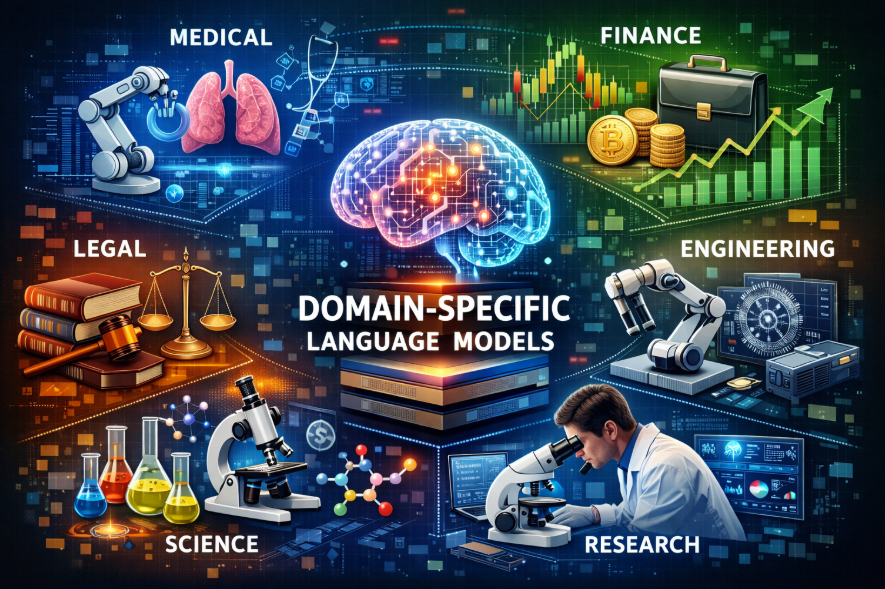
Artificial Intelligence (AI) is changing the way people work, learn, and communicate. One important part of AI is language models, which help computers understand and generate human language. Many popular systems like OpenAI’s ChatGPT or Google’s Google Bard are examples of general language models Domain-Specific Language Models. These models are trained on a wide range of topics.
However, sometimes businesses and professionals need AI that focuses on a specific field. This is where Domain-Specific Language Models (DSLMs) become very useful. These models are trained for a particular industry or subject, such as healthcare, finance, law, or technology.
In this article, we will explain what domain-specific language models are, how they work, their benefits, and where they are used.
What Are Domain-Specific Language Models?
A domain-specific language model is an AI model trained to understand language in a specific field or industry. Instead of learning general knowledge from all types of text, it focuses on a particular domain.
For example:
- A medical language model understands medical terms and research papers.
- A legal language model understands contracts and legal documents Domain-Specific Language Models.
- A finance language model understands banking and financial reports.
Because these models are trained on specialized data, they can give more accurate and relevant answers in that area Domain-Specific Language Models.
How Domain-Specific Language Models Work
Domain-specific language models are built using the same basic technology as general AI models. Many of them are based on transformer architecture, which is used in models like BERT and GPT-4.
The process usually includes three steps:
Also Read:AI-Native Development Platform
1. Base Model Training
First, a general language model is trained on large datasets such as books, websites, and articles. This helps the AI learn basic grammar and language patterns Domain-Specific Language Models.
2. Domain Data Collection
Next, developers collect data related to a specific field Domain-Specific Language Models. For example:
- Medical journals
- Legal case studies
- Financial reports
- Technical manuals
3. Fine-Tuning
The model is then fine-tuned using this specialized data. This helps the AI understand industry-specific vocabulary and context Domain-Specific Language Models.
Benefits of Domain-Specific Language Models
Domain-specific models provide many advantages compared to general AI systems Domain-Specific Language Models.
1. Higher Accuracy
Because the model focuses on one field, it understands technical terms better and produces more precise answers Domain-Specific Language Models.
2. Better Decision Support
Professionals can use these models to analyze reports, summarize documents, and assist in decision-making Domain-Specific Language Models.
3. Improved Productivity
Workers can save time by using AI to automate tasks such as writing reports, answering questions, and reviewing documents Domain-Specific Language Models.
4. Industry Customization
Companies can build AI tools designed specifically for their business needs Domain-Specific Language Models.
Common Use Cases of Domain-Specific Language Models
These specialized models are being used in many industries today Domain-Specific Language Models.
Healthcare
In healthcare, DSLMs help doctors analyze medical records, research papers, and patient reports Domain-Specific Language Models. They can also assist in medical diagnosis and clinical documentation.
Finance
Banks and financial companies use language models to analyze financial data, detect fraud, and generate financial reports Domain-Specific Language Models.
Legal Industry
Legal professionals use domain-specific models to review contracts, summarize legal documents, and search case law Domain-Specific Language Models.
Customer Support
Companies create domain-focused AI chatbots that understand their products and services. This improves customer support efficiency Domain-Specific Language Models.
Technology and Software Development
Developers use specialized AI models to help write code, debug programs, and understand technical documentation Domain-Specific Language Models.
Challenges of Domain-Specific Language Models
Even though DSLMs are powerful, they also have some challenges Domain-Specific Language Models Domain-Specific Language Models.
Data Availability
Specialized training data can be difficult or expensive to collect Domain-Specific Language Models Domain-Specific Language Models.
Training Costs
Training AI models requires strong computing power and large datasets Domain-Specific Language Models Domain-Specific Language Models.
Bias and Errors
If the training data contains bias or mistakes, the model may produce incorrect results Domain-Specific Language Models .
Maintenance
Industries change over time, so the model must be updated regularly with new data Domain-Specific Language Models.
The Future of Domain-Specific AI
Domain-specific AI models are becoming more important as industries adopt artificial intelligence Domain-Specific Language Models. Many companies are building custom AI systems for their businesses.
For example, technology companies like Microsoft and IBM are developing AI tools for healthcare, finance, and enterprise solutions.
In the future, we may see more specialized AI assistants designed for doctors, lawyers, engineers, teachers, and many other professionals Domain-Specific Language Models.
These tools will help people work faster and make better decisions.
Conclusion
Domain-specific language models are a powerful type of artificial intelligence designed for particular industries. Unlike general AI models, they focus on a single field and provide more accurate and useful information.
By using specialized training data and fine-tuning methods, these models help professionals in healthcare, finance, law, technology, and many other sectors Domain-Specific Language Models.
As AI technology continues to grow, domain-specific language models will likely become an important tool for businesses and professionals around the world.
Frequently Asked Questions (FAQs)
- What is a domain-specific language model?
A domain-specific language model is an AI system trained to understand language within a specific field such as healthcare, law, or finance Domain-Specific Language Models.
- How is it different from a general language model?
A general language model learns from many topics, while a domain-specific model focuses on one industry for higher accuracy Domain-Specific Language Models.
- Where are domain-specific models used?
They are commonly used in healthcare, finance, legal services, customer support, and technology industries Domain-Specific Language Models.
- Why are domain-specific models important?
They provide more precise information and help professionals complete tasks faster Domain-Specific Language Models.
- Can companies build their own domain-specific AI models?
Yes. Many companies train custom AI models using their own industry data to improve efficiency and decision-making Domain-Specific Language Models.